Stacking Tesamorelin and MOTS-C with Retatrutide: what the research says
Why metabolic researchers pair a GLP-1/GIP/glucagon triple agonist with a GHRH analogue and a mitochondrial peptide — the mechanisms, the published numbers, and how combined protocols are designed.
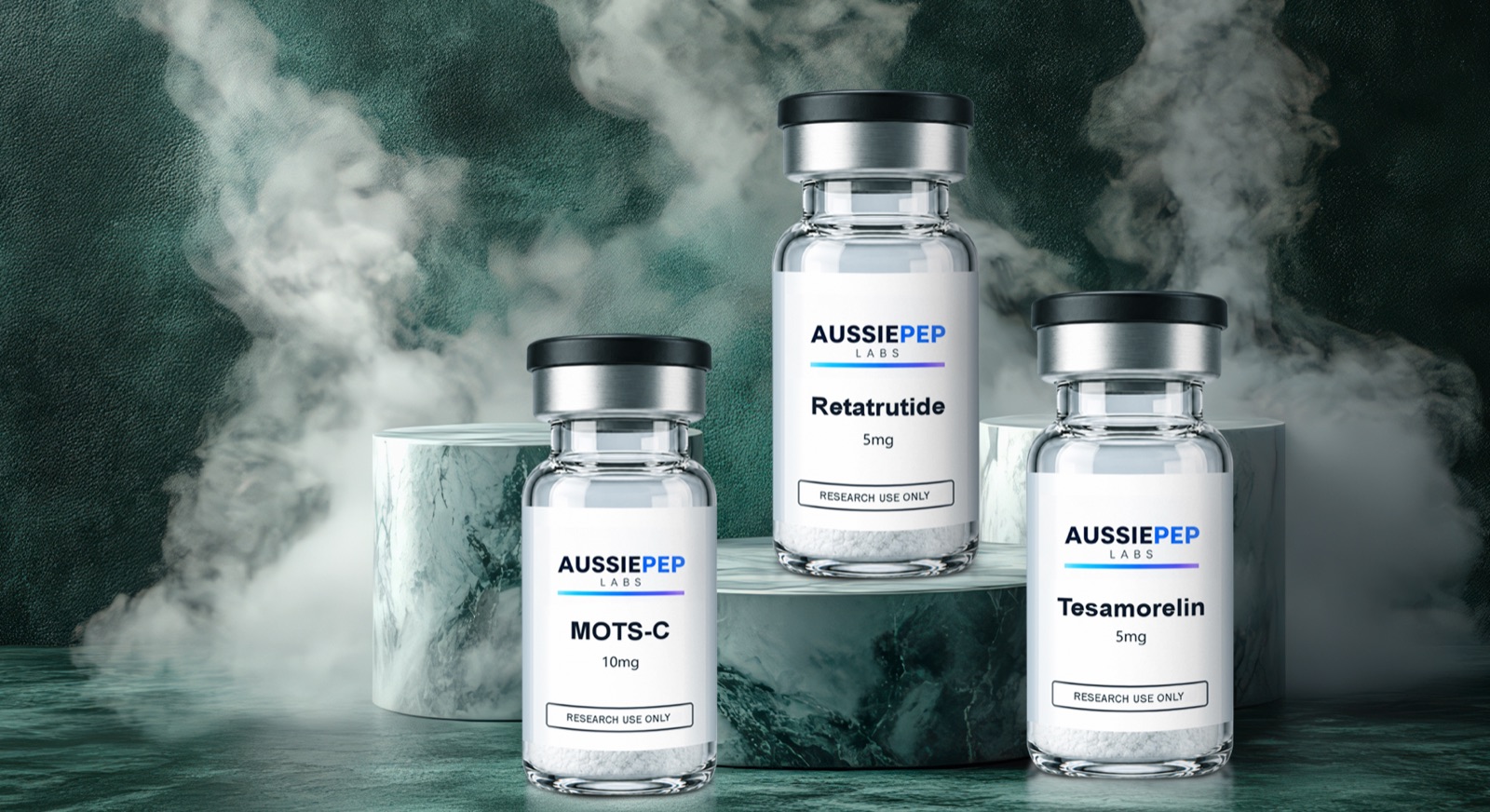
Weight-loss peptides rarely stay in their own lanes. Ask what metabolic researchers are pairing in 2026 and one combination keeps coming up: a GLP-1/GIP/glucagon triple agonist alongside a growth-hormone secretagogue and a mitochondrial peptide. Here's what each of the three compounds does, what the published literature actually shows, and why combined protocols are being designed around them.
Retatrutide: the triple agonist
Retatrutide is a single peptide that activates three receptors at once — GLP-1, GIP and glucagon. The first two slow gastric emptying and reduce energy intake, the mechanisms behind semaglutide and tirzepatide. The glucagon arm is the differentiator: it raises energy expenditure and drives hepatic fat oxidation directly, rather than only reducing intake.
In its published phase 2 trial (New England Journal of Medicine, 2023), the highest weekly dose produced a mean body-weight reduction of about 24% over 48 weeks — the largest figure reported for any incretin-based agent at that time — with phase 3 studies still under way. Imaging sub-studies also reported marked reductions in liver fat.
Tesamorelin: the visceral fat specialist
Tesamorelin is a stabilised analogue of growth-hormone-releasing hormone (GHRH). Rather than replacing growth hormone, it stimulates the pituitary to release it in natural pulses, which preserves the feedback loops that blunt crude GH dosing.
It remains the only compound ever approved by the FDA specifically for reducing visceral adipose tissue — the deep abdominal fat around the organs — on the strength of trials in HIV-associated lipodystrophy that showed visceral fat reductions in the range of 15–18% over six months, with comparatively little effect on subcutaneous fat. That selectivity is exactly why it keeps appearing in body-recomposition research: visceral fat is the metabolically troublesome depot.
MOTS-C: the mitochondrial signal
MOTS-C is unusual: it's encoded inside the mitochondrial genome itself. It activates AMPK, the cell's low-energy sensor, and in animal work improves insulin sensitivity and fat oxidation — earning it the label of an "exercise-mimetic". In a 2021 Nature Communications study, late-life treatment improved physical capacity in aged mice; early human data remain limited to small trials.
Why researchers combine the three
Incretin-driven weight loss has a well-documented catch: a substantial share of the weight lost — 25–40% in some analyses — is lean tissue, not fat. That observation is the seed of most stacking hypotheses.
The logic of this particular trio is that each compound works a different axis:
- Energy intake — retatrutide reduces how much energy comes in and shifts the liver toward fat oxidation.
- The GH axis — tesamorelin biases loss toward visceral fat and supports the anabolic signalling that intake restriction suppresses.
- Cellular energetics — MOTS-C targets how efficiently the remaining tissue burns fuel.
It's an elegant hypothesis — and an unproven one. No published human trial has tested these three compounds together. Anyone claiming established synergy is ahead of the data; what exists is a mechanistic rationale and single-compound evidence.
Designing a combined protocol
Research groups studying combinations tend to follow a few principles worth knowing about:
- Staggered introduction. Compounds are introduced one at a time, so an effect — or an adverse signal — can be attributed to its source.
- Composition endpoints, not scale weight. DEXA or MRI-based visceral fat measurement separates fat loss from lean loss; total mass alone can't.
- Function alongside composition. Metabolic studies increasingly pair imaging with glucose tolerance and respirometry, since the point of preserving lean mass is preserving function.
The bottom line
Retatrutide, tesamorelin and MOTS-C attack fat metabolism from three genuinely different directions — intake, hormonal axis and mitochondria — which is why the combination is one of the most-discussed protocols in current metabolic research, and why we stock all three.
All three compounds are available individually — Retatrutide, Tesamorelin and MOTS-C — or together as the Visceral Fat Research Stack.
Everything AussiePEP Labs supplies is for in-vitro laboratory research only — not for human or veterinary use. This article summarises published literature; it is not medical, dosing or usage advice.
For in-vitro laboratory research only. Not for human or veterinary use, and nothing published here is medical advice.